Physician Epidemiologist & photographer. I inherited my mother's photography business and collection and our lives have been swept into the beauty and obsession. I am expanding the available images, learning the ropes, practicing patience, watching my own daughter develop her "good eye" & becoming a naturalist (I hope).
For Karen, a friend entering breast cancer therapy
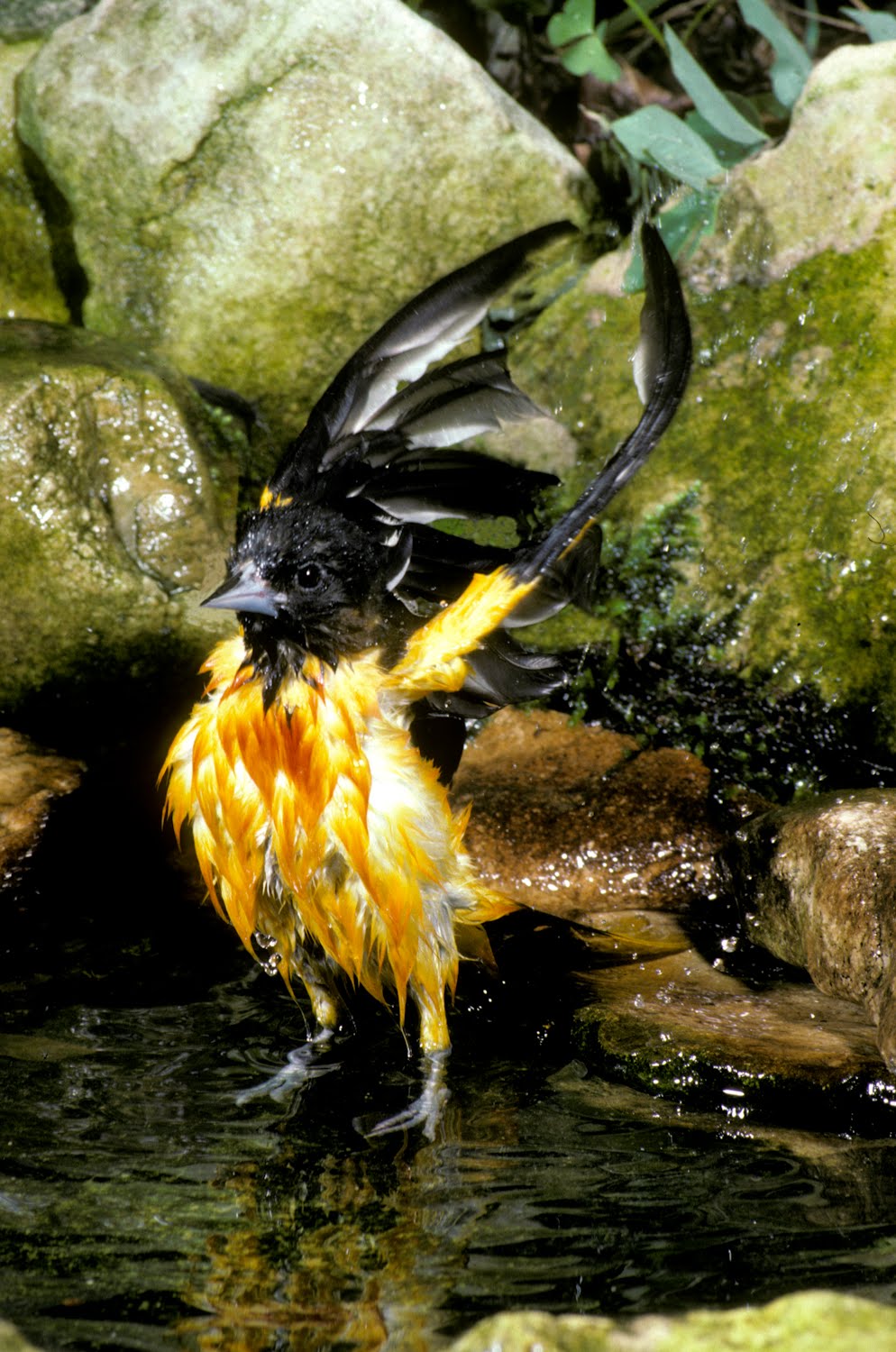
Health advice: It is important to move about, stretch, and look silly as part of your health regimen. This particular example is avian aqua yoga a natural method for stretching and strengthening muscles and bones. It is done by advanced practitioners in little pools of water presumably to stay cool. Splash about and raise a wave.
Pull your arms way up over your head--a salute to the sun, practice balance and looking tall.
Note: Your hair looks much better than theirs however, a little suit of feathers might cheer you up and the silver shoes on the Baltimore Oriole could be just the ticket to feeling less vulnerable around oncologists and chemotherapy. If we can be any help procuring the various accoutrement just say so.
We are thinking of you. If you want more health advice from the little creatures just let me know.
This is a great read but, even better, it is a fantastic listen. It was heartily recommended by a friend with the specific instructions that I should get the audio version. Part way through the book she had to buy the audio version so she could keep "reading" while she drove cross country. She recommended that I go directly to that version and, she was right, as usual. I do not think my imagination could have done justice to the richness of the voices that these women, the readers and the author have created. Natalya and I have been listening to it over and over as we drive back and forth and back and forth and back and.... well, you get the idea, to Maine. We are working on respectable imitations of the voices we have heard.
One of the rewards is the chance through the story to talk deep history with my daughter. Another is to remember those years-- to feel, again, the nuanced but unyielding divisions that existed; maintained through thousands of tiny gestures and unspoken supports. At the risk of playing into some horrible cultural gaffe let me say that my ears were hungry for the timbre, rhythm, and resonance of a black woman's voice.
It is a kind book, one that makes me stop short when I realize I cannot talk about it with my mother. A heart stopping realization. There was such pleasure in finding things that I knew down to the marrow of my bones would make her laugh or cry. There is so much to it and savoring all that is in it, even the hard parts, is a pleasure. We would have, my mother and I, talked about all the invisible lines, the guy wires that support a terrible injustice making it huge, impossible to ignore, and obscenely invisible. A society spends enormous energy pretending not to see large injustices. There is a next wave of the civil rights movement that belongs to those of us that are of "mostly-European-American" race.
There is much to be said about race and class. Regrettably, it has become difficult to talk about and therefore to learn. I believe Ms. Stockett has contributed to the possibility of conversation.
Have you read the book?
Sharon
Thursday, May 6, 2010
Nature Photography: Grandma peels back the curtain
Gay wrote naturalist picture stories as letters to her grandchildren. Fortunately, most of Gay's grandchildren liked icky things like bugs and snakes. During visits to Missouri one grandchild or another would come in beaming and grubby opening his/her hands saying "look what I found grandma". Gaywould peer down, finding frogs, insects, slugs, little turtles, snakes, cocoons, or some other little form of life. She would gasp with wonder and pleasure, clap her hands and either name it in Latin or run for the right guide. What a pleasure! Then she would tell some outrageous fact about the creature-- science fiction has nothing on science for really great stories.
This is a story about the Rough green snake, Opheodrys aestivus,
also known as a grass snake or whip snake.
We have added a few details to her original story(in blue).
By Gay Bumgarner October 2004
and Friends May 2010
"The other day in the garden I found two one inch by 1/2 inch white blob-like things. At first I thought they were mushrooms but I couldn't see a stem and the shape wasn't right. I picked them up.
They were firm but not hard, a little sticky, and they actually did feel like mushrooms. They were eggs, snake eggs! I wasn't sure exactly what kind but I figured they would be interesting to watch and photograph so I moved them inside to my terrarium (that little world in the glass box upstairs in the guest bedroom/ studio) so I could watch the whole thing unfold. I spent some time looking in the books to be sure what I could expect to see and what "it" might need. I called my friends and experts in the vivarium world and was given the advice that they were most likely green snake eggs or ring neck snakes.
I went upstairs often to look in on them and see what was happening. I wasn't sure how fast they might hatch since I didn't know how long ago they were laid. On the third day I saw this little face peering out. cute!
It was a Rough green snake, alert, looking around, sticking out its tongue (smelling), and taking its first glimpse of the world. It breaks through (pip) by making a tear on the side of the egg with its egg tooth. I set up my cameras waiting for more action but, amazingly, it stayed right there in the egg for two days. It would pull his/her head back or poke it out but, seemed to be quite content. I wasn't sure if it was waiting, building up its strength, or even stuck, I wondered, should I rescue it-- Snake Midwife?The other one did the same thing and for awhile they both had their heads poking out looking at each other and the world.
Eventually they came out. It was about the size of a small worm with a thread-like tail.
When I put my finger down toward him to see if I could touch him this is how he responded. Adorable just like a big snake.
He wanted to frighten away whatever this "threat" was. As you can see he has no teeth and he is quite harmless but he is putting on a good show and sometimes the show is everything. Both eggs hatched and I returned them to the garden where I found the eggs. Rough green snakes are arboreal and live in trees which is unusual in the US. Their green color helps them hide among the leaves in trees. When the wind blows they purposely wave their bodies like a branch. In fact when these snakes hang on branches, they maintain rapid, rhythmic, side to side head movements. Some say these motions enhance the snakes vision and ability to see in three-dimensional range, some say it helps them hide.I say it definitely makes them look cool.
In this very brief video clip by the state of Missouri you can see the head movements of the baby snake.
Even more exciting..... a couple of days ago Ben my garden helper saw a bobcat in the shed up in the woods. I find this very exciting since bobcats are hard to see especially since they are nocturnal (stay up all night). THE END.
I love you all
Mother-grandmother Gay"
Thanks to Sharon McDonnell, Suzanne Rhodes, Meg Harper, Karen Joyce and Natalya McDonnell forediting, expertise, and questions.
------------------------------------------------------------------------
Additional Questions from our editorial board and readers: 1. Snakes in eggs?
Yes. Some snakes are born from eggs that are laid outside the mother. Other egg-laying snakes besides the rough green snake are black rat snakes, bullsnakes, kingsnakes, racers, worm snakes, ring-necked snakes. As a more "evolved" or advanced alternative there are snakes that retain their young inside their bodies in yolk sacs until they are completely developed. These include water snakes, garter snakes, brown snakes, copperheads, cottonmouths and rattlesnakes.
Mother Green snakes can can keep the eggs in their bodies until they are almost ready to hatch or lay them. The longer they are in their mother the more quickly they hatch because they stay warmer. So, if you see an egg on the ground it might hatch in 4 days or 2 months.
2. They stay in the eggs? Is that typical? Aren't they are hungry or restless?
Female Rough green snakes sometimes lay their eggs in communal sites on the ground or in the holes of trees. As a young snake develops within the egg, a small egg tooth grows on the tip of its snout; the snake uses this tooth to slit the shell when hatching and then sheds it after hatching.
Baby snakes may stay in the egg for 48 to 72 hours after pipping, in order to absorb the remainder of the yolk sac.
3. What do baby green snakes eat? Did Gay have to bring them food?
These snake east all sorts of soft bodied or hairless insects (including moths, butterflies, crickets, grasshoppers, and many caterpillars) and spiders. A snake will find prey by vision or the chemosensory systems on it's tongue. Since these snakes are not venomous, nor constrictors and don't have teeth they simply grab, gum, and swallow. There is a video of this on YouTube that involves a cricket that I spared you.
Yes, Gay fed them little crickets and mealworms before she put them back in the wild. Yummm.
4. If this is a rough green snake is there a smooth green snake?
You betcha. Rough and smooth depend on whether they have scales (rough) also known as keels.
5. They live in trees?
As the University of PA site points out, the name of this wee green snake is very informative. "It is a “serpent” (“ophios”) that lives in trees (“drys”) that is active in the warm months of summer (“aestivus”)". They like climbing branches to high sunny spots to keep warm. But, they are comfortable on the ground and if they need to they can swim quite well too.
Want to see a picture of a copperhead? Picture of copperhead snake
How about a funny snake picture? Snake and dragonfly
If you have more questions or would like us to explore your favorite animal or natural event please send us a suggestion in the comments.
Sharon
Sunday, May 2, 2010
Welcome to first health through imagery blog. Join us. If you want to see background about the health through imagery project check it out at this link: Health through Imagery described.
You can’t pick up a magazine or newspaper without finding a cacophony of dogmatic information about what to eat, how many miles to walk each day, and the latest magic pill that will ensure you a long and healthy life. Confused? Here’s the good news: Your life (or lifestyle) is more or less what makes you healthy. Not to take anything away from professional health care, but your health is in your own hands, no expertise needed. In fact, many of your urges and pleasures are not sinful but are actually good for you and part of your own unique recipe to produce “health”, well being, and vitality.
Health advice via experts is not universally healthful. Trust me about this. I am a health expert. In part this is because advice about things like nutrition (aka eating), exercise (moving about or playing) may be based on science that is likely to change dramatically. Frequently these dictates are also difficult to follow because they are hard to comprehend and hard to do.
As an example, in 2007 Gary Taube wrote a mind-changing article in the Sunday New York Times Magazine called “Science and the Stairmaster: Why most of us believe that exercise makes us thinner—and why we’re wrong”. This article uproots every deeply held notion about the relationship of exercise, eating, and weight loss and its validity has been consistently confirmed. In summary: “….despite half a century of efforts to prove otherwise, scientists still can’t say that exercise will help keep off the pounds. This is not to say that there aren’t excellent reasons to be physically active . . . But there’s no reason to think that we will lose any significant amount of weight, and little reason to think we will prevent ourselves from gaining it.”
Oh no! Another magic bullet gone the way of bran, Vitamin E, margarine, low fat diets, and sugar substitutes. Could the essential flaw be our powerful desire to reduce health to that single magic bullet? Instead of holding out for just one thing that will save or change our lives perhaps instead we need a variety of them, many of them fun things that make us feel good.
As pleasing as a simple linear relationship might be—food in, weight out—it doesn’t seem to be true. We live in relationship, in dynamic interaction with our cellular and universal environments. The science of health proves over and over that humans are complex systems and social animals. The answer to our ongoing search for good health will be multifaceted and include what we think, if we love, if our lives have pleasure, if we eat real food and drink water. The commonsensical but scientifically grounded words of Michael Pollen about eating, “Eat food. Not too much. Mostly plants.” strikes just the right tone.
In this spirit, as a nearly reformed health expert, I offer the following advice: Start and stick with things that consistently make you feel fit, able, and energetic, no matter what the experts say. Become an expert about yourself.
As an example of how we each need to feel our way to health, let’s continue with advice about exercise. In animal studies, if Animal #1 enjoys running on its treadmill it will benefit from the exercise. However, if animal #2 is obliged to run every time animal #1 does, Animal #2 not only doesn’t necessarily benefit from the exercise but also may actually be at greater risk of ill health from such things as ulcers and cardiovascular disease. Exercising against your will, when it is a duty, may actually be bad for you. (ref R Sapolsky) Animal #2 may love to square dance or make rock pathways, laugh out-loud or god-forbid, read.
In the particular environment of a person’s life, any one of these things may contribute to well being. Thus, the best advice about exercise and your health must come from you and it depends on how you “feel” about that exercise. Apparently the more it resembles fun or play the more contributes to your health and happiness.
Coming next…. The nearest thing to a magic bullet—social connection or “lets make friends”.
Reference links
Gary Taube- New York Times Sunday Magazine, “Science and the stairmaster: Why most of us believe that exercise makes us thinner—and why we’re wrong” (http://nymag.com/news/sports/38001)
Robert Sapolsky- multiple sources. A fun one is a podcast he has made on his excellent book “Why Zebras don’t get ulcers” and another on what baboons can teach about stress us available from Stanford University for free download at: Sapolsky podcast
Micheal Pollen newest book "Food Rules" is fun, well written and scientifically sound. Great for kids or adults.
Wednesday, April 21, 2010
This is Jim Bumgarner Sr with his loyal friend "Bugsy" the wild (watch) turkey. Jim wrote a short piece about discovering Bugsy that I include below. This picture comes from the gallery "Humanimals: family" and you can jump there to see what it is like to grow up in a wildlife conservation rescue area. Click here for: Gallery of family and fauna in the valley
For several years my wife and I raised wild orphan animals. We raised several squirrels, several raccoons, four foxes, four fawns, one coyote and one wild turkey. We enjoyed them all but if I had to pick a favorite it would have to be Bugsy, our wild turkey.
I was mowing at my farm one spring day and I scared up a wild turkey. I found her nest. It had eight eggs in it. I had been told that if a nesting turkey was disturbed like this, they would never return to the nest. I left this area for several hours and then walked back to check the nest. There was no mother and the eggs were getting cold. I took four of the eggs home and put them in a small-borrowed incubator. My conscience was clear when I returned to the nest the next day and found it destroyed.
I was really quite surprised when two weeks later two of the eggs hatched. One baby died in a few hours. The second one was quite healthy and was drinking water and eating poultry food quite quickly. For the first few days we kept her in a cardboard box in the garage but she took to the outdoors quite quickly and was soon finding bugs and half jumping and half flying up to the lower tree branches. I was afraid of predators at night so every evening I would walk her to the shed. She would jump and fly to the rafters and stay there until I opened the door the next morning and when I return she would immediately fly down and spend the day in the yard and garden. If I would go out on the deck and sit on a bench she would come up and sit beside me always on my left side and stay there as long as I remained. Bugsy liked to follow us on our walks along the paths through the woods-- always looking for bugs. She would fly off from us but return in a few minutes. We’d see her fifty yards away or so from the house with other turkeys but she never went with them.
When she was hungry she would peck on the picture window until someone fed her. In the spring she would still come sit by me on the deck. She would accompany my wife to the garden. One day I heard a yelp from the garden and my wife said Bugsy pecked her on the rump when she was leaning over.
I guess Bugsy liked the response she got because this act was repeated many times. If I heard a yelp from the garden, I knew that Bugsy had gotten her again. Bugsy also started the habit of pecking on my pant leg and shoes. I assume this was her attempt to play. [Editors note: This was his generous interpretation—the rest of us felt were far less charmed and believed we were being warned and thus, tried to steer clear of Jim’s “watch turkey”].
That summer, Bugsy ate all the bugs around the house so I had to start bringing her grasshoppers from the farm. I would catch hundreds of them with a butterfly net while driving my ATV. I would put about dozen in plastic bags and keep them in the refrigerator. She soon knew the meaning of the plastic bags and when I’d come out with one she would come running.
We were surprised when Bugsy stayed with us through the winter. By now she was putting herself to bed in the shed and eventually she started sleeping high in the trees. We would feed her and give her a bit of grain every day. After sixteen months with us, Bugsy left for good. We never saw her again but later we learned a bit more.
In an area that lies to the northwest of us there is a neighborhood called Timberhill. One day a woman living there heard a tapping sound on her picture window. She looked up and was amazed to see a turkey on her deck pecking on her window. She opened the door and the turkey ran toward her. She evidently was frightened by this behavior and ran to the phone and dialed 911. When she calmed down, she reasoned that this was someone’s tame turkey so she threw some birdseed out. She and her next-door neighbor fed Bugsy for several weeks - James E. Bumgarner
Check out other wacky photos of otherwise respectable people living with animals and for my family-- I just had to share. No one will recognize you guys, really.
Saturday, April 10, 2010
Picturing Peace
Often I find that art comes to me as I pass it, or seek it out in various collections and shows. The emotional response is one then that I have not sought out, but rather one that is impressed upon me. Not that this is a negative way to experience art, but it is a usual one. Recently I found myself looking for an emotional response, a state of being; I was looking for peace. Not peace in the world peace sense, but images that evoked a sense of peacefulness. Searching through Gay's images I chose several that evoked that response, and over the next several weeks I sat with them, returned to them, and found they continually brought on a sigh, relief and release. Peace.
I then thought about what it was that evoked that response and that, along with some of those images, is what I share here.
In the image above--taken on the Olympic Peninsula--I like the sense of the near, far and middle distance. It speaks of potential and possibility as much as it speaks of a contentment with what lies behind, and of the present. The interplay of purples and greens, the snow on the far mountains, these speak of change, promise and contentment.
Three birds sitting on the barbed wire in the last not-quite-warm sun of a late summer afternoon, two looking forward, one looking back. They appear so content; accepting of the imminent change of seasons, the combination of warm sun and slight chill on the breeze, being where they are, looking both forward and back without judgment. Just being.
And finally, here is this little fellow, coming out of the grass, stopping to look into his future, enjoying the warm sun on his back, warm mud and gentle eddies of the water around his legs and feet. Like the birds he is so present, going from one place to another, yet so content with what is and what was.
So, I realized that when I picture peace I look for a sense of possibility without the anxiety of contemplating change that we so often instill in our path through life. So often we mull over our options, try to figure out what will be, try to look behind and change what we can't. That is a state I find anxiety producing and not particularly constructive. It was interesting to me to look for peace in images, find it, and consider what evoked that feeling: possibility, change and contentment with what is and was. These images (and others I chose) serve as reminders of, and vehicles to that place, that state of being.
I am going to try this with other states of being in future posts, but perhaps you would like to see what says peace to you, or what says... something else you seek.
Look through Gay's images and see what speaks to you. Make a lightbox so you can return to those images (if you need to know how to do this please e-mail), and consider...what says "peace" to you? What says.....?
Please comment below or e-mail to respond to this post, share and let us know what you find.
This is a favorite image of Gay's and a favorite place for her. Here is how she described it in writing for people that liked the picture.
"This picture was taken with late sun shining in autumn on the north fork of Grindstone creek and limestone cliffs. This creek is the type known as a “loosing creek” because when it rains it rises rapidly, sometimes as much as 12 ft, but within a few days loses is extra water into the many tributaries which have also emptied into it. The creek then moves on and joins the south fork of the grindstone, then to the Hinkson and then to parts beyond.
The forest here is native oak, hickory, maple, serviceberry and sycamore plus many others. This section of creek usually has water in it except for a few weeks if no rain falls for many weeks. There are deep holes, such as exists at the base of the cliff you see. During one very dry summer, the hole had water holding fish and frogs and a Green Heron and northern water snake (harmless) tried to share the hole but finally disputed the territory.
Notes from Sharon-- a little back story for the picture and the place.
There are many photos of this spot. It was essentially her back yard and on special nights she would turn on the lamps hidden in the bluffs and the dramatic rock faces would shine and skitter with shadows.
Gay and Jim placed a bench there to watch things happen. There is a picture of Jim on the bench with Bugsy his companion turkey (or guard turkey). He could hide there with bugsy, have a secret smoke sometimes, rest from the weed eating, supervise my brother rappelling while trimming the trees. There is also a wonderful, romantic photo of Gay and Jim siting on that bench together in the fall (K1300a_Older couple shares a bench.tif) --
The area was changed greatly by the city trying to improve the flow of sewerage in pipes placed under the creek. Gay hounded them for 2 years across her property and made sure they did a good job. She marked every tree, and kept them to their word. The new job they made can be seen in [E0512_Grindstone creek after major city public works.tif] and the bench where they sat returned to its place.
In 2008, during her final summer we spent a lot of time on the deck looking over the lake and beyond to the bluffs. The efforts of maintenance had scaled down with age and Jim's absence-- unnoticeable to any normal human gardener but a source of wry interest to her.
The Canada geese were nesting and presented an excellent low-key distraction and mini-drama. After years of building among the reeds and grasses on the lake shore the geese finally abandoned the strategy. Too many eggs and goslings were lost to Raccoons, turtles, and other predators. Thus, almost 15 after the lake was adopted by Canada geese they began to build their nests on the bluffs- on a flat spot part way up. The view of the nest was perfect from the house but there were tradeoffs and new hazards. Now instead of easing into the water for a first swim the gosling had to “jump” or “fly-fall” down to the creek 15 feet below then a hike up the creek edge over the dam and into the lake. Not a clear improvement overall.
In the summer of 2008 on a perfect day Gay and I were on the deck watching the lake. The male goose came and offered the female her short respite from the nest. The two of them swam together for a brief time every afternoon. They muttered and honked and sounded as if they were catching up on all the events of the world. This quiet pair swimming together -- such a romantic sight and a deserved break.
But, then, they were out of the water up on the dam, upset, honking, running back and forth across the dam. They were yelling and flapping at something happening in the nest. We were puzzled and mesmerized. But, suddenly on the ledge where the eggs sat something pushed one of the eggs off into the creek onto the rocks below. Then we were up, standing, binoculars fixed to the spot, shouting at this unknown malevolent force, no superpowers to help. We watched disbelieving as one after another the remaining 3 eggs were pushed out of the nest, first to the edge where it would teeter and almost rest then it was pushed again. They fell one at a time, lit by the sun, in breathtaking slow motion, orbs alight falling in a perfect arc; disappearing below our view.
My mother gripped her IV pole and the two of us stood on the edge of the deck, holding hands and me offering her a place to lean. We were weeping, outraged and shouting along with the parents whose noise was deafening... all to no effect. Finally, I had to know what it was that would do this, to know if something could survive. It was just days before they would hatch. I took off running across the garden, across the dam, and down the embankment to the base of the bluffs and the creek, to do what?
It was quiet. Whatever did this damage was apparently not interested in the product. I could find nothing. Then down a bit I saw it.... One egg floated in the water midstream, was it intact, was it too cold?
It was cracked but not through and through and it seemed there was some little movement perhaps inside. I carried it to the dam where mother and father were pacing, honking, flapping...beside themselves. Why had they not flown to threaten whatever it was? Were they so certain of the loss or the chance of something worse?
I brought the egg to a soft sunny place in the long grass near them, they were unhappy to see me but overwrought. I backed away. They approached cautiously, sniffed and poked with their beaks, but quickly dismissed it-- dead, too damaged, not theirs, wrong, they wouldn’t own or tend it.
My mother said, leave it, they wont claim it, there is something they know perhaps about the odds and the effort, and there are plenty of others that will want it come dark.
I hated it, that unknown snake or rat that decimated the nest. I wanted signs of the good universe, of the arc of justice and not of waste. If I was facing my mothers death it seemed doubly awful to have the fierceness of the pruning forces be the sign I was to somehow use to help me. S.McDonnell